Products
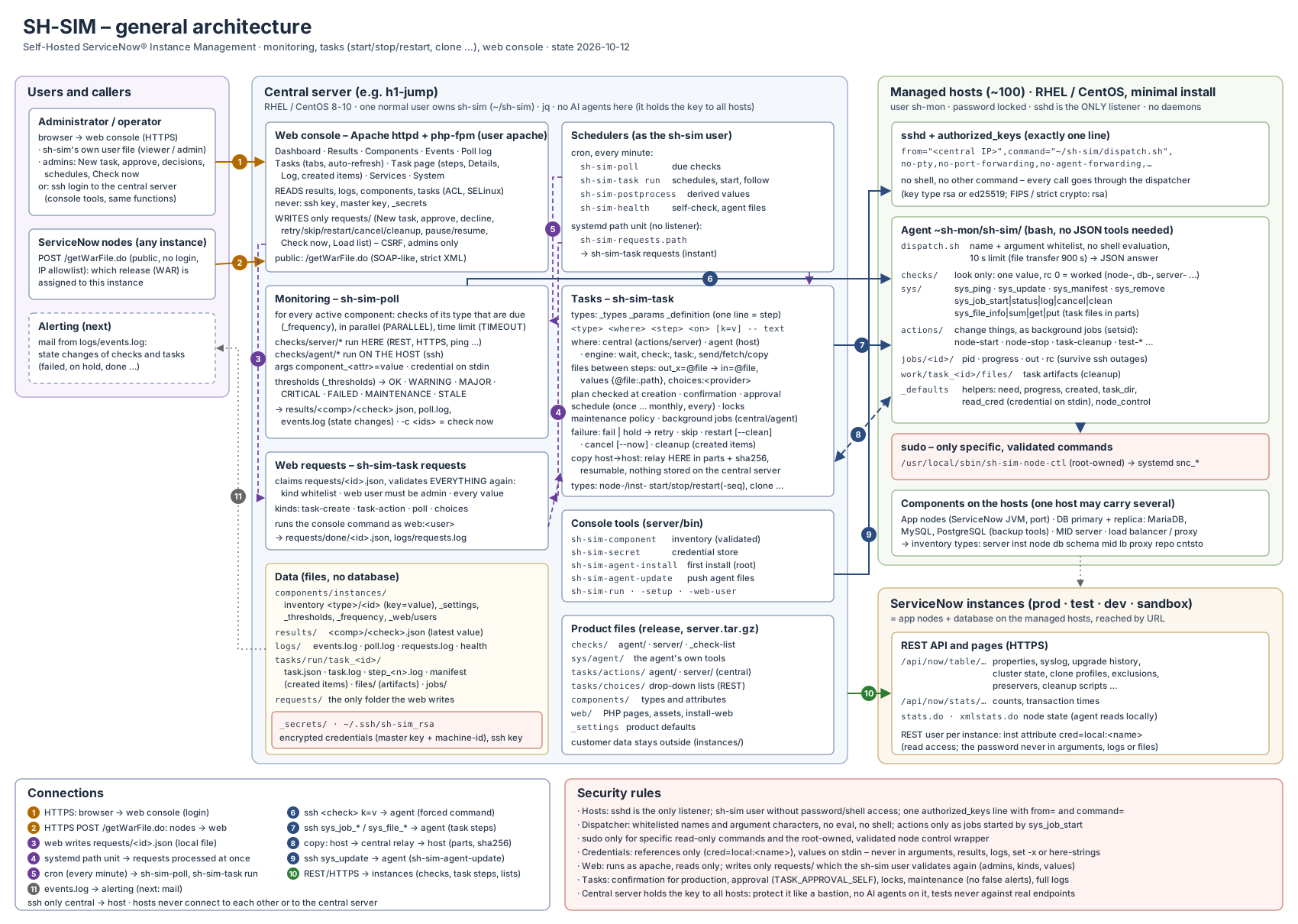
SH-SIM — Self-Hosted ServiceNow® Instance Management
The gap it fills
ServiceNow's published feature availability for Private Stack lists Instance Clone as unavailable. A manual method exists. Anyone who has used it knows what that means in practice.
Instance Data Replication is unavailable. Automated upgrades are available only where the deployment can reach the internet — which excludes air-gapped and heavily restricted environments, precisely the environments most likely to be running Private Stack in the first place.
These are not oversights. They are capabilities that depend on ServiceNow-hosted services, and customer-operated deployments do not have them.
SH-SIM is what we built instead, over more than a decade of running these environments.
What it does
Cloning
Repeatable instance cloning for Private Stack, without ServiceNow's cloud tooling. Production to test, production to development, with the data handling and masking steps built into the process rather than bolted on afterwards.
Upgrades
Planning, rehearsal and execution automation for family releases and patches, including in air-gapped environments.
Deployment
Consistent instance deployment across your estate, so that environments actually match each other.
Monitoring
Platform-level visibility built for self-hosted deployments, where ServiceNow's own instance observability is not available to you.
Specifications
| Supported ServiceNow family releases | Zurich and Australia (most recent family releases) |
|---|---|
| Supported databases | MariaDB, MySQL, PostgreSQL |
| Supported operating systems | RHEL 7/8/9, CentOS 7, CentOS Stream 8/9, and compatible distributions. Base OS only — no special dependencies beyond standard httpd and PHP. |
| Air-gapped support | Yes. Installation packages are transferred into the central installation repository manually. |
| Deployment model | Delivered as a package with an install script and setup instructions, plus an install guide and a user guide. |
| Licensing | Per connected Private Stack instance (PROD, TEST, DEV) and its size, billed annually. |
| Pricing | Quoted after a short scoping call — ask us. |
| Support model | Updates, support service, SLA. |
| Source escrow | Not applicable today — you receive the complete SH-SIM source with your licence, so there is nothing held back to escrow. If a future release withholds any part of the source, an escrow arrangement via Escode or Codekeeper can be agreed at that point. |
See it in action
Short screen recordings from our own test environment, without audio — click any clip to play.
Cloning
Running a clone end to end — the components involved, creating a new clone, and tracking its progress as it runs.
Installation
Installing SH-SIM itself and its initial configuration, captured step by step with on-screen captions.
Inventory
Configuring the components SH-SIM manages — instances, nodes, servers and databases — with example screens for each.
Web interface
A walkthrough of SH-SIM's web interface, running and tracking the operations above without the command line.
Command-line interface
The same operations driven from the command line, for scripted or air-gapped workflows.
Scheduling
Scheduling an SH-SIM task ahead of time — most often cloning, but also backups or a full instance refresh, such as a nightly sequential restart across all nodes.
Data transfer
How SH-SIM moves data between servers during a clone — a backup taken on the source server, transferred to the target.
SH-VIM — KVM Starter Kit for Private Stack Infrastructure
A companion to SH-SIM, not a packaged product in its own right: a runbook, a deployment guide and a set of sample KVM scripts and instance templates, built on Red Hat® Virtualization and the KVM hypervisor, for standing up and operating Private Stack infrastructure — VM pattern content preparation, cloning, duplication, deployment, decommissioning, ongoing management and remote filesystem updates. Template definitions are included for several ServiceNow® instance variants.
Licensed as an annual subscription, with the script and template library updated twice a year. Available as part of an infrastructure automation engagement, or on its own — ask us for scope and pricing. Supported on current KVM, tested and run on RHEL 9. Complete source is provided, so a separate source-escrow arrangement does not apply.